

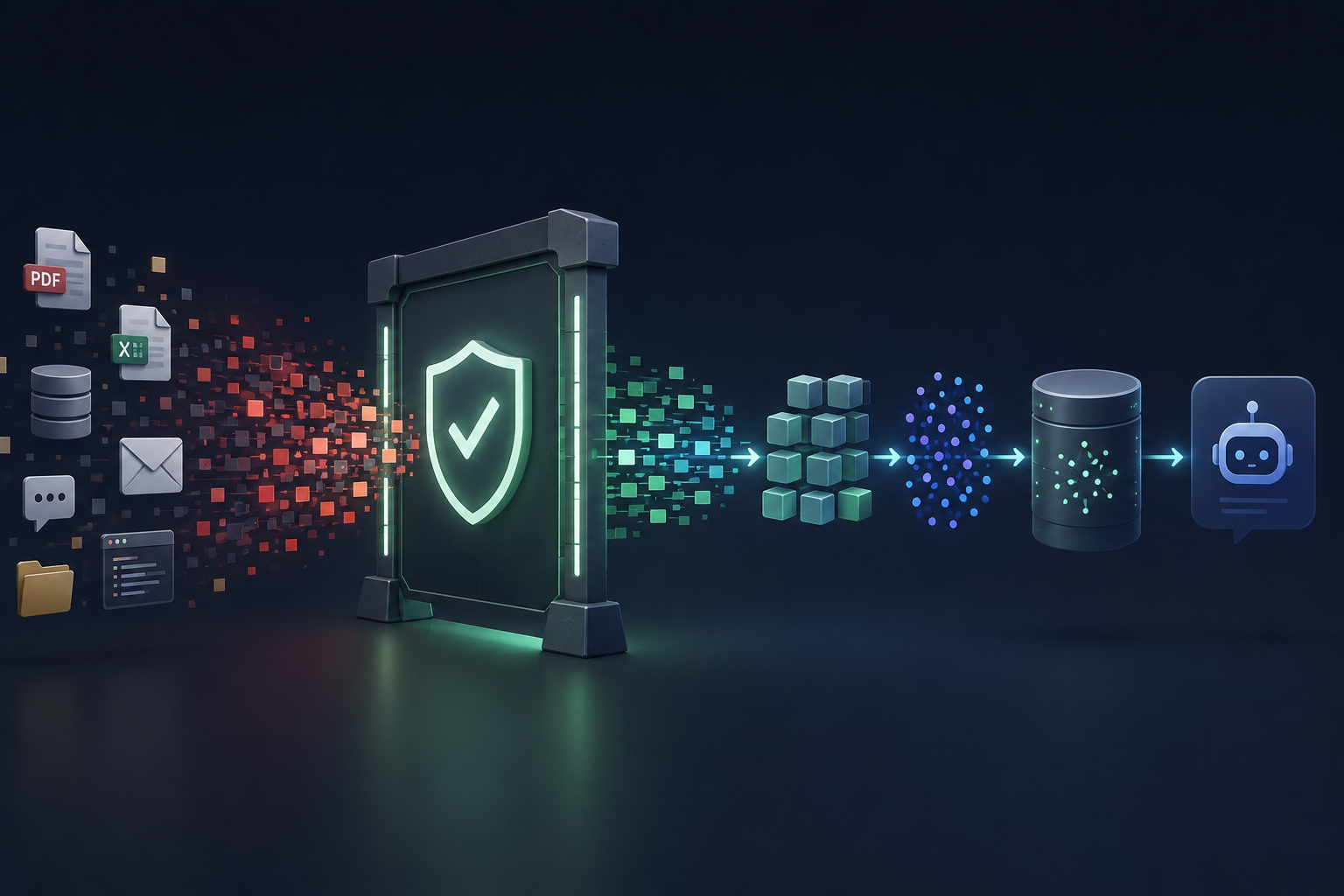
Vector stores are quickly becoming a core component of enterprise AI architecture. They allow organisations to index large volumes of information, retrieve relevant context, and power AI assistants, copilots, search tools, and retrieval augmented generation solutions.
However, as more enterprise data is pushed into vector stores, a critical security question is emerging:
Are we securing the data before it becomes AI searchable?
For many organisations, the answer is not yet clear.
The common focus is on securing the AI model, securing the prompt, securing the application, or controlling access to the vector database. These controls matter. But they do not solve the root problem if sensitive data has already been ingested, chunked, embedded, and stored.
Once sensitive information has entered the AI pipeline, it becomes much harder to control.
The Vector Store Security Problem
A vector store is not just another database.
It is a searchable knowledge layer designed to make information easier to retrieve. That is its value. It is also its risk.
If source documents contain personally identifiable information, customer records, payment data, commercial secrets, credentials, or regulated content, that information can be carried into the AI pipeline.
The typical flow looks like this:
- Source data is selected
- Documents are extracted
- Content is chunked
- Chunks are converted into embeddings
- Embeddings and metadata are stored in a vector database
- AI applications retrieve relevant chunks at runtime
The danger is that many organisations focus their security attention from step four onwards.
That is too late.
The real control point is before chunking.
Why Chunking Changes the Risk Profile
Chunking breaks source content into smaller segments so that it can be embedded and retrieved efficiently. This is a normal and necessary part of most AI retrieval pipelines.
But chunking can also fragment context.
A full document may clearly show that a section contains sensitive customer information. Once broken into smaller chunks, the same content may be harder to classify, harder to govern, and harder to trace back to its original sensitivity.
For example, a customer record might be split across multiple chunks:
Name and address in one chunk
Account history in another chunk
Support notes in another chunk
Transaction references in another chunk
Each chunk may look less sensitive in isolation, but together they may still expose regulated or confidential information.
This is why sensitive data discovery and masking must happen before chunking, not after.
Embeddings Are Not a Safe Place to Fix Data
A common misconception is that once text is converted into embeddings, the sensitive data is no longer present in a usable form.
That assumption is dangerous.
Embeddings are mathematical representations, but they are still derived from the original content. They are designed to preserve semantic meaning. If sensitive information influenced the embedding, then the vector store may still support retrieval patterns that expose, infer, or reconstruct sensitive context.
More importantly, most vector stores also retain the original text chunk or associated metadata alongside the embedding. That retained text is often what gets passed back into the AI prompt during retrieval.
Trying to clean up the vector store after ingestion is complex. You need to identify affected chunks, remove or replace embeddings, update indexes, regenerate metadata, and prove that the old sensitive content is no longer retrievable.
That is operationally messy and difficult to evidence.
The better approach is prevention.
The Left of Chunking Principle
To secure a vector store properly, organisations should adopt a simple principle:
Sensitive data must be discovered, classified, masked, or excluded before chunking begins.
This means the AI ingestion pipeline should not start with raw enterprise data. It should start with governed, profiled, and approved data.
Before any document is chunked, the organisation should ask:
Does this content contain PII?
Does it contain payment data?
Does it contain health, financial, legal, or regulated information?
Does it contain internal credentials, secrets, or access tokens?
Does it contain commercially sensitive information?
Is this content approved for AI retrieval?
Should this content be masked, redacted, tokenised, subsetted, or excluded?
Only after these checks should the data move into the chunking and embedding process.
What Good Looks Like
A secure vector store pipeline should include several control points before ingestion.
1. Data Profiling
Source data should be profiled to identify sensitive fields, patterns, and content types. This includes structured data, semi structured data, and unstructured documents.
Profiling should detect known patterns such as names, addresses, phone numbers, emails, account numbers, payment details, dates of birth, tax identifiers, and other regulated attributes.
It should also support business specific rules. For example, policy numbers, claim references, customer identifiers, internal project codes, or application specific sensitive fields.
For more on the role of profiling, see Unveiling the Power of Data Profiling.
2. PII Discovery and Classification
Sensitive data should be classified before it enters the AI pipeline.
Not all sensitive data carries the same risk. Some content may be public. Some may be internal. Some may be confidential. Some may be regulated. Some may be strictly prohibited from AI ingestion.
Classification allows organisations to apply different treatment rules depending on risk.
3. Masking and Redaction
Where data is useful but sensitive, masking should be applied before chunking.
This may include replacing names, account numbers, addresses, or other sensitive values with realistic but non sensitive alternatives.
In other cases, redaction may be more appropriate. For example, removing secrets, credentials, payment card details, or highly regulated information entirely.
The key point is that the chunking engine should only see data that has already been secured.
For a practical introduction to protecting PII, see How to Mask PII Data.
4. Validation
Masking is not complete until it is validated.
Organisations should verify that sensitive values have been removed, replaced, or protected according to policy. This validation should happen before embedding, not after the vector store has already been populated.
Validation should also create evidence. This matters for audit, compliance, and internal risk management.
This is where automated compliance validation becomes important. Enov8’s Data Compliance Suite DevOps Edition is designed to help teams profile, mask, validate, and evidence compliance across the data lifecycle.
5. Metadata Governance
Metadata can be just as risky as the document content.
A chunk may be masked correctly, but its metadata may still expose a customer name, file path, department, case number, system name, or confidential classification.
Metadata should be reviewed and governed as part of the same pre chunking control process.
Access Control Is Necessary, But Not Sufficient
Some organisations assume that vector store security can be solved through access control alone.
Access control is important, but it is not enough.
If sensitive data is stored in the vector database, then the organisation must manage every downstream access path, every AI application, every prompt flow, every retrieval rule, every administrator role, and every integration.
That creates ongoing risk.
A stronger model is to combine access control with data minimisation.
Do not just ask who can access the vector store.
Ask whether the sensitive data should be in the vector store at all.
Why This Matters for Enterprise AI
Enterprise AI is moving quickly. Teams are experimenting with copilots, document search, knowledge assistants, support bots, engineering assistants, and operational intelligence tools.
The business value is clear.
But without strong data controls, vector stores can become unmanaged reservoirs of sensitive enterprise knowledge.
This creates several risks:
Regulatory exposure
Customer privacy breaches
Internal data leakage
Commercial confidentiality issues
AI responses based on inappropriate data
Poor auditability
Difficulty proving what data was ingested
Difficulty removing sensitive data after the fact
The more AI becomes embedded into business operations, the more important these controls become.
The Practical Architecture
A safer enterprise AI pipeline should look like this:
Source Data
Data Profiling
PII and Sensitive Data Discovery
Classification
Masking, Redaction, or Exclusion
Validation
Approved AI Ready Data
Chunking
Embedding
Vector Store
Controlled Retrieval
AI Response
This architecture shifts security to the left.
It ensures that sensitive data is controlled before it becomes searchable AI context.
The Role of Test Data Management Thinking
This is where traditional Test Data Management disciplines become highly relevant to AI.
For years, TDM has focused on profiling, masking, subsetting, generating, validating, and governing data for safe use outside production.
The same principles now apply to AI data pipelines.
The question is no longer only:
Can we provide safe data for testing?
It is also:
Can we provide safe data for AI?
The disciplines are closely aligned. Both require discovery, classification, masking, validation, repeatability, and evidence.
AI does not remove the need for data governance. It increases it.
Final Thought
Securing a vector store is not just a database security exercise.
It is a data lifecycle control challenge.
The most important decision happens before the first chunk is created.
If sensitive data is allowed into the pipeline too early, every downstream control becomes harder. If sensitive data is profiled, classified, masked, and validated before chunking, the organisation starts from a much stronger position.
The rule is simple:
Secure the data before you chunk it.
That is the foundation for safer enterprise AI.