


What are Database Gold Copies? – An SDLC View

Golden Copy

The Essence of Database Gold Copies

In the software development realm, particularly within the testing phase, a database gold copy stands out as an indispensable asset. It serves as the definitive version of your testing data, setting the benchmark for initializing test environments. This master set is not just a random collection of test data; it represents a meticulously selected dataset, honed over time, encompassing crucial test cases that validate your application’s robustness against diverse scenarios.

Why Gold Copies are Indispensable

Gold copies are imperative for they ensure a stable, dependable, and controlled dataset for automated tests. In contrast to the ever-changing and sensitive nature of production data, gold copies remain static and anonymized, allowing developers to use them without the threat of data breaches or compliance infringements.

The Pitfalls of Production Data Testing

While testing with production data may seem beneficial due to its authenticity, it poses numerous challenges. Real data is often unstructured, inconsistent, and laden with unique cases that are difficult to systematically assess. Moreover, utilizing production data for testing can extend feedback loops, thereby decelerating the development process.

Advantages of Contrived Test Data

Contrived test data, devised with intent, is aimed at evaluating specific functionalities and scenarios, rendering issue detection more straightforward. Gold copies empower you to emulate an array of scenarios, inclusive of those rare occurrences that might seldom arise in actuality.

Gold Copies and Legacy Systems

In contexts where legacy systems are devoid of comprehensive unit tests, gold copies offer significant advantages. They facilitate regression testing via the golden master technique, comparing the current system output with a recognized correct outcome to pinpoint variances instigated by recent changes.

Integrating Gold Copies into the Development Workflow

To effectively incorporate gold copies within your development workflow, commence by choosing a production data subset and purging it of any sensitive or personal details.
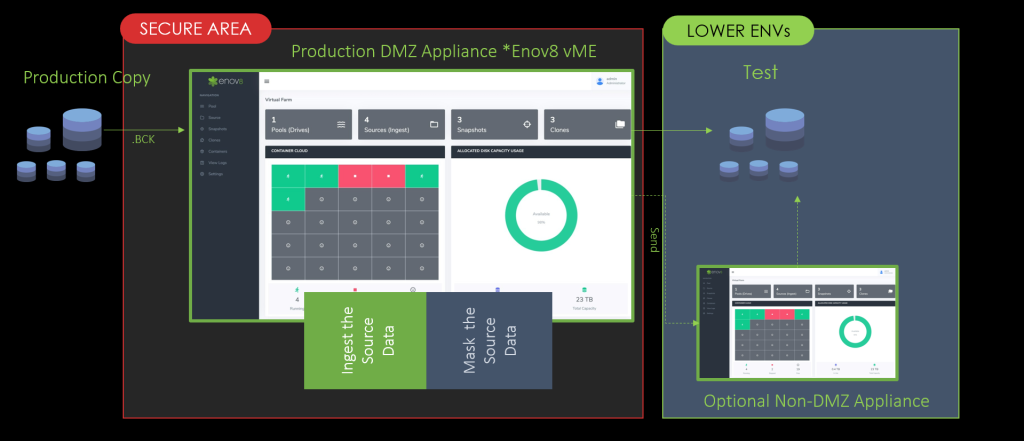
Gold Copies will typically be held in a Secure DMZ for purpose of Obfuscation. In this example the databases are held in an Enov8 VME Appliance.
An example Gold Copy DMZ using Enov8 vME

Subsequently, amplify this data with scenarios that span both frequent and infrequent application uses. Before test deployment, maintain your gold copy within a version control system and mechanize the configuration of your test environments. This strategy enables swift resets to a consistent state between tests, assuring uniformity and reliability across all stages of deployment, from testing to production environments.

Summation

In summation, database gold copies are instrumental in upholding software quality and integrity throughout the development cycle, offering a reliable basis for automated testing and a bulwark against the unpredictability of real-world data.


The Risk of Production Data in Test: Harnessing Synthetics

The Vulnerable Link in Data Security

In the world of data security, the age-old adage “a chain is only as strong as its weakest link” holds true, especially when it comes to your organization’s data security. This vulnerability is amplified by the fact that your data security is only as robust as your least informed and least cautious employee. Astonishingly, a staggering 74% of data breaches can be attributed to the “human element,” while the financial aftermath of an average data breach rings in at a staggering $4.35 million.

The Risky Practice of Testing with Production Data

Enter the precarious practice of transferring sensitive production data to less secure testing environments. This seemingly needless procedure drastically expands the potential attack surface of your data. The looming question is: why does this practice persist?

The Allure and Peril of Production Data for Testing

The inclination to use production data in testing environments often stems from well-intentioned motives. Developers frequently resort to employing real data to test new features or troubleshoot issues, as it mimics real-world scenarios.

Balancing Testing Needs and Security Imperatives

Despite its apparent benefits for testing, this practice presents a substantial security risk. Organizations can pour significant resources into fortifying production databases and the associated infrastructure, deploying an array of safeguards, firewalls, and scanners. However, once this data migrates to a less secure domain such as a test or development environment, its vulnerability increases significantly.

Consequences of Mishandled Data

Actual production data often houses sensitive customer information, encompassing details like names, addresses, and financial specifics. Mishandling this information can result in breaches that not only tarnish a company’s reputation but also lead to severe legal and financial repercussions.

Lessons from Legal Fines

A poignant reminder is a €1.2 billion fine under the EU General Data Protection Regulation (GDPR), accompanied by a staggering tally of 1,700 fines issued since its inception in 2018.

Beyond the Surface Solution

During discussions with vendors at the European InfoSec event, a recurring suggestion for dealing with production data in non-production environments was to eliminate this practice and revoke access.

The Challenge of Realistic Testing

While valid, this response doesn’t address the underlying problem. There are situations where developers or testers require real-world scenarios to simulate specific application conditions. Without a robust solution for provisioning and generating test data, relying on production data becomes the sole option. Consequently, exceptions arise, posing unacceptable risks.

From Masking to Synthetic Data

To tackle these challenges, a modern approach to test data creation is gaining traction: the use of synthetic data. Unlike masked data, synthetic data is artificially generated, eliminating the risk of exposing sensitive information.

The Power of Synthetic Data

Synthetic data is generated using algorithms based on application scenarios and business logic. This approach ensures the creation of a diverse dataset, offering comprehensive coverage for testing and development purposes.

Bridging Privacy and Rigorous Testing

Synthetic data facilitates thorough and realistic testing, mitigating the potential for costly bugs and security vulnerabilities. Furthermore, it can generate accurate data on demand, bypassing the often substantial development time spent sourcing or generating data.

Embracing Secure Testing and Development

By adopting synthetic data, developers and testers can fulfill their roles efficiently without subjecting the organization to the perils associated with using actual production data.

Strengthening Security and Streamlining Development

The strength of your data security strategy pivots on its weakest point. If live production data remains in non-production domains, it serves as a weak link in the chain.

Empowering Data Security

Establishing robust test data management practices strengthens your data against breaches. It is imperative to equip your workforce with the tools and knowledge essential for confidently navigating the intricate domain of data security. The adoption of synthetic test data generation offers a secure solution that streamlines and optimizes testing and development endeavors.

Do I really need to Anonymize my Data & How Might I Do it?

Introduction

Data privacy is a critical concern for businesses and individuals alike. With the amount of personal and sensitive data being collected by organizations, the need to protect this information has never been more important. An effective way to protect data privacy is through data anonymization. But what is data anonymization and why is it important? In this post, we will delve into the world of data anonymization and explore the different techniques and methods that organizations can use to protect sensitive data.

What is Data Anonymization?

Data anonymization is the process of removing or modifying personally identifiable information (PII) and other sensitive data from datasets to protect the privacy of individuals. The goal of data anonymization is to make it impossible to identify an individual from the data, while still allowing organizations to use the data for legitimate purposes such as research, analysis, and marketing. Data anonymization techniques can range from simple redaction or masking of sensitive data to more complex methods such as pseudonymization, hashing, and synthetic data generation. Anonymizing data is becoming increasingly important in today’s world where data breaches and cyber attacks are becoming more common. Organizations that fail to properly anonymize data can face legal and financial consequences as well as reputational damage.

Why Anonymize Your Data?

There are several important reasons why organizations should anonymize their data:

  1. Legal and Regulatory Requirements: Organizations that collect and store personal data are subject to various laws and regulations regarding data privacy and security. Anonymizing data is often a data compliance requirement under these laws, such as the General Data Protection Regulation (GDPR) in the European Union and the California Consumer Privacy Act (CCPA) in the United States.
  2. Avoiding Financial and Reputational Damage: If personal or sensitive data is exposed through a breach or other means, organizations can face significant financial penalties and reputational damage. For example, in 2019, Equifax agreed to pay up to $700 million in fines and compensation to consumers after a data breach exposed the personal data of over 140 million people.
  3. Protecting Against Insider Threats: Employees, partners, and third-party vendors can all pose a risk to data privacy and security. Anonymizing data can help protect against insider threats by limiting access to sensitive information.
  4. Facilitating Data-Driven Decision Making: Data anonymization can enable organizations to use big data and analytics to make informed business decisions without compromising privacy. By anonymizing data, organizations can still access and analyze large datasets while protecting the privacy of individuals.

Industries that Should Anonymize Data

While data anonymization is important for any organization that collects and stores personal or sensitive data, there are certain industries that are particularly at risk for data breaches and face more stringent regulations. Some of the industries that should prioritize data anonymization include:

  1. Healthcare: Healthcare organizations handle large amounts of sensitive patient data and are subject to strict regulations such as the Health Insurance Portability and Accountability Act (HIPAA) in the United States and the General Data Protection Regulation (GDPR) in the European Union. Anonymizing patient data can allow healthcare providers to conduct research and analysis while protecting patient privacy.
  2. Financial Services: Financial services companies collect and store sensitive financial data such as credit card numbers and bank account information. Anonymizing this data is important to comply with industry-specific privacy regulations such as the Payment Card Industry Data Security Standard (PCI DSS) and to protect against financial fraud and identity theft.
  3. Education: Educational institutions collect personal information about students such as their names, addresses, and grades. Anonymizing this data is important to protect student privacy and comply with regulations such as the Family Educational Rights and Privacy Act (FERPA) in the United States.
  4. Energy: Energy companies collect data on energy usage to better serve their customers. Anonymizing this data can allow energy companies to analyze usage patterns while protecting customer privacy.

Methods of Data Anonymization

There are several methods that organizations can use to anonymize data. Some of the most common methods include:

  1. Masking: This method involves replacing sensitive data with a masking character, such as an asterisk or a zero, to hide the actual value. For example, a social security number might be masked as *–-1234.
  2. Pseudonymization: This method involves replacing identifying information with a pseudonym, or a fictitious name, to protect privacy. For example, a name might be replaced with a randomly generated identifier such as “User 1234”.
  3. Hashing: This method involves converting data into a fixed-length string of characters that cannot be reversed to reveal the original data. For example, a password might be hashed using a cryptographic algorithm so that the original password cannot be retrieved.
  4. Redaction: This method involves removing or obscuring sensitive data from a dataset. For example, a credit card number might be redacted so that only the last four digits are visible.
  5. Encryption: This method involves encoding data using an encryption key so that only authorized users can access it. For example, a credit card number might be encrypted so that it can only be accessed by someone with the decryption key.
  6. Generalization: This method involves removing specific details from a dataset to make it less identifiable while still retaining the data’s usefulness. For example, a person’s age might be generalized to a range (e.g., 25-30) rather than a specific number.
  7. Synthetic Data Generation: This method involves creating a new dataset that mimics the characteristics of the original dataset, but contains no actual data from the original dataset. This allows for data analysis without revealing any sensitive information.

in summary, there are various methods for anonymizing data, each with its own strengths and weaknesses. Organizations should choose the most appropriate method based on their specific needs and the level of privacy protection required.

How to Anonymize Your Data

When it comes to anonymizing data, there are a few best practices that organizations should follow to ensure that their data is properly protected:

  1. Understand the Data: Before anonymizing data, it’s important to understand what data is being collected and how it’s being used. This can help identify which data needs to be anonymized and which techniques are most appropriate.
  2. Choose the Right Technique: There are many different techniques for anonymizing data, and the choice will depend on the specific needs of the organization. For example, some techniques may be better suited for structured data such as social security numbers, while others may be better for unstructured data such as text.
  3. Test the Results: After anonymizing data, it’s important to test the results to ensure that the data still provides value and is useful for the intended purposes. This can involve analyzing the data and comparing it to the original dataset to ensure that the data is still accurate and relevant.
  4. Keep the Data Safe: Anonymizing data does not necessarily mean that it’s fully protected. Organizations should take steps to secure the data, such as using encryption and access controls, to ensure that it cannot be accessed by unauthorized parties.
  5. Stay Up-to-Date: Data privacy regulations and best practices are constantly evolving, so it’s important for organizations to stay up-to-date on the latest developments and adjust their data anonymization practices accordingly.

In addition to these best practices, there are many tools and services available to help organizations anonymize their data, such as data masking software and cloud-based data anonymization services. These tools can help automate the data anonymization process and ensure that the data is properly protected.

Conclusion

In today’s data-driven world, protecting personal and sensitive information has never been more important. Data anonymization is a critical tool for organizations to protect against legal and financial penalties, reputational damage, and insider threats while still enabling data-driven decision making. By choosing the right technique and following best practices, organizations can effectively anonymize their data and ensure that it is properly protected. As data privacy regulations continue to evolve, it’s important for organizations to stay up-to-date on the latest developments and adjust their data anonymization practices accordingly.